
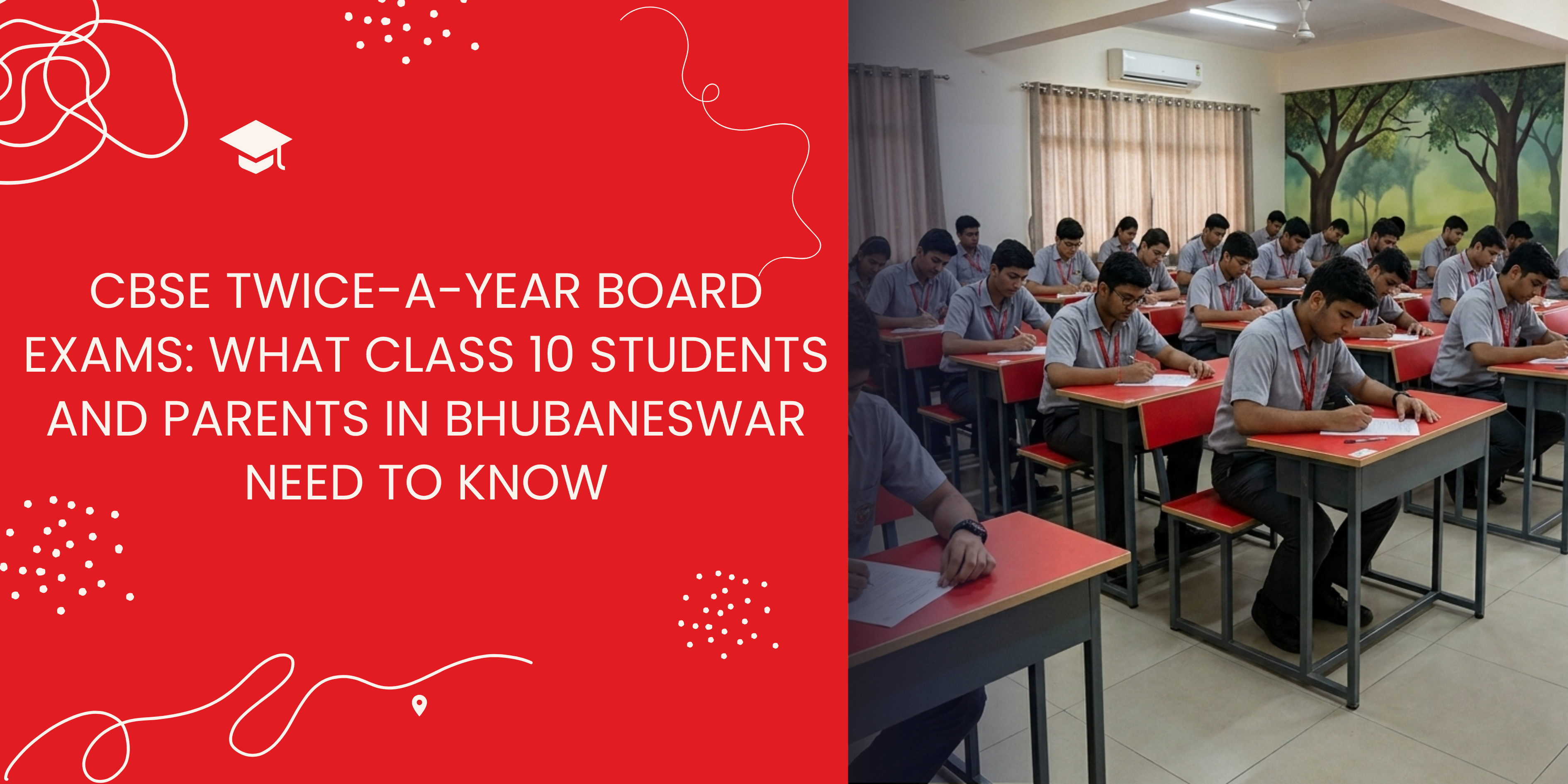
CBSE Twice-a-Year Board Exams: What Class 10 Students and Parents in Bhubaneswar Need to Know

The Central Board of Secondary Education (CBSE) has introduced a twice-a-year board examination system for Class 10 from the 2026–27 academic session, marking one of the most significant changes to the board assessment framework in recent years. Aligned with the vision of the National Education Policy (NEP) 2020, the reform aims to make examinations more flexible, reduce the pressure of a single high-stakes examination, and encourage competency-based learning.
Naturally, this shift has prompted important questions among students and parents. Will every student have to appear twice? Which score will count? How should students prepare? And how are schools in BBSR adapting to support learners under the revised pattern?
This blog answers these questions by explaining what the new examination system means in practice, what remains unchanged, and how students and parents can prepare with confidence in the years ahead.
CBSE Twice-a-Year Board Exams at a Glance
| Aspect | Detail |
|---|---|
| Applicable Session | Class 10, starting with the 2026–27 academic session |
| Number of Attempts | Two — a first (main) examination and a second (optional) examination in the same academic year |
| Is the Second Exam Compulsory? | No. The first exam is mandatory; the second is optional for improving marks or clearing a subject. |
| Which Score Counts? | The better of the two scores is considered for the final result. |
| Timing | First exam in February; second exam (where opted) in May. |
| Objective | Reduce the pressure of a single high-stakes exam and give students a genuine second opportunity. |
At its core, the reform gives students a structured second chance within the same academic year, rather than making them wait an entire year to retake a subject. The first exam remains the primary assessment; the second is a genuine opportunity, not a requirement.
What Has Changed for Class 10 Students?
The most visible change is the change from one examination opportunity to two – but the deeper change is in how performance is assessed.
What Has Changed for Class 10 Students?
| Feature | Previous Pattern | New Pattern (2026–27) |
|---|---|---|
| Exam Attempts | One annual exam | Two attempts in the same year |
| Improvement Option | Only via compartment/supplementary exam | Built into the same academic year |
| Question Style | Largely descriptive | A greater share of competency-based and application questions |
| Pressure Profile | Entire year rests on one attempt | Performance spread across two opportunities |
Because the better score from either attempt is what counts, students are no longer defined by a single day’s performance. At the same time, the growing share of competency-based questions means rote memorisation carries less weight than genuine conceptual understanding. In effect, the reform rewards consistent, year-round learning over last-minute preparation.
What Students Need to Know
The flexibility of a second attempt does not reduce the importance of the first. Students should learn a few practical points that are worth keeping in mind:
- Treat the first exam as the main event, not a trial run — it is the mandatory attempt and the one every student must sit.
- Build understanding through the year rather than relying on the second attempt as a safety net; the second exam is meant for genuine improvement, not a substitute for preparation.
- Since competency-based questions ask students to apply concepts, focus on understanding the ‘why’ behind topics, not just memorising answers.
- Use the gap between the two exams productively — it is a real opportunity to strengthen specific subjects, not extra holiday time.
- Keep track of eligibility requirements, including attendance, since these determine whether a student can appear for the second attempt at all.
How Schools in BBSR Can Support Students Under the New Pattern
A reform of this scale places real responsibility on schools, not just students. schools in BBSR that adapt well to this system tend to focus on a few consistent things: teaching that builds conceptual clarity rather than exam-oriented shortcuts, regular internal assessments that mirror the competency-based format, and mock examinations that familiarise students with the revised question style well before the actual exam.
Equally important is individual academic mentoring — identifying which students may benefit from the second attempt and preparing them for it specifically, rather than treating it as a one-size-fits-all option. Open communication with parents about a child’s readiness and consistent counselling support to manage exam-related stress round out what a well-prepared school environment looks like under this new framework.
At ODM Public School, these principles are embedded within the learning ecosystem. Through continuous assessment, experiential learning, academic mentoring, and close collaboration with parents, the school nurtures learners who are prepared not only for examinations but also for lifelong learning. This holistic approach mirrors what many families now seek while exploring Schools in BBSR for their children’s academic journey.
What This Means for Students: Dr Satyabrata Minaketan Explains
“The twice-a-year format is not about giving students an easier path — it is about giving them a fairer one. A single exam day should never be the sole measure of a year’s learning. Our responsibility as educators is to make sure students walk into either attempt with genuine conceptual clarity, not just exam readiness, because that clarity is what stays with them well beyond Class 10,” says Dr Satyabrata Minaketan, Chairman, ODM Educational Group.
The CBSE twice-a-year board exam system reflects a broader shift toward flexibility without lowering academic expectations. For Class 10 students, it means less pressure riding on a single exam day. For parents, it means a clearer picture of how performance is assessed and what support their child may need along the way. Schools with strong, consistent academic support — from classroom teaching to mentoring to counselling — are best placed to help students make the most of this change, whatever they eventually decide about the second attempt.
FAQ
Is the second CBSE board examination compulsory for Class 10 students?
No. The first examination is mandatory for all students. The second is optional and meant for those who want to improve their marks or clear a subject.
Which marks are considered for the final result if a student appears for both exams?
The higher of the two scores is used in the final result.
Can students choose to appear for only some subjects in the second exam?
The second attempt is generally intended for students looking to improve specific subjects or clear a compartment, rather than repeating the full exam across all subjects.
Will the Class 10 syllabus change under the new system?
The syllabus itself remains the framework students are already familiar with; the main shift is in the exam structure and a greater share of competency-based questions.
How should students prepare differently under the new pattern?
The emphasis moves toward understanding concepts and applying them, since competency-based questions test reasoning rather than recall alone. Consistent preparation through the year matters more than exam-time cramming.
How can parents support their child through this change?
Parents can encourage balanced study routines, maintain open communication with teachers, reduce unnecessary pressure, and focus on their child’s overall well-being alongside academic performance.
How are schools in BBSR adapting to the new CBSE exam pattern?
Many schools in BBSR, including ODM Public School, are strengthening continuous assessment, introducing mock exams aligned with the new question style, and expanding academic mentoring and counselling support to help students adjust.